Transform Operations Through Intelligent Digital Manufacturing
Integrate Industry 4.0 technologies in India to connect production systems, use real-time data, and improve efficiency, quality, and operational control across manufacturing operations.
Contact Us
Smart Factory and Industry 4.0 Integration in India
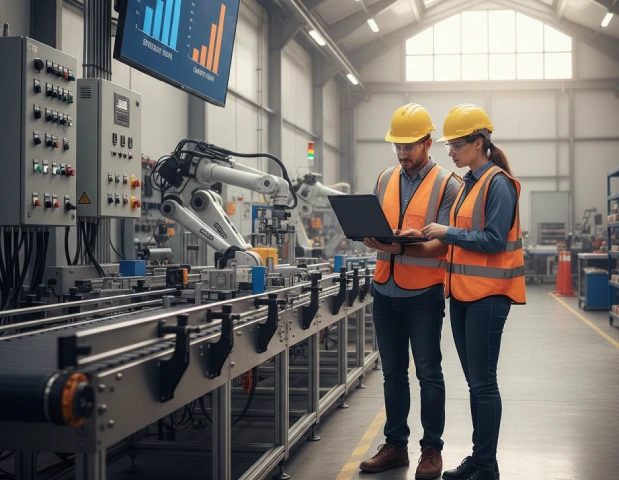
Smart factory and Industry 4.0 integration in India enable manufacturers to build connected, data-driven production environments using automation, IoT, and advanced analytics. With India accelerating digital manufacturing under initiatives like Make in India and PLI schemes, adoption of Industry 4.0 technologies is growing across sectors. Studies indicate that smart factory implementation can improve productivity by 15-25% and reduce operational costs by 20-30% through real-time monitoring and predictive decision-making. Despite forecasts that India will achieve USD 16.7 billion in industrial automation market size by 2034, according to CII, only less than 35% of Indian manufacturing companies have reached the advanced level of digital adoption. However, due to the National Manufacturing Policy formulated by DPIIT and productivity requirements within the PLI scheme, many Indian manufacturers now need to implement this technological shift, but very few of them have a plan of how to achieve that transition.
At IMARC Engineering, we provide smart factories and Industry 4.0 integrations in India by assessing digital maturity, creating a roadmap, and implementing technology upgrades. Our services include implementation of IoT-enabled sensors, machine learning analytics, and other technologies required to optimize and automate manufacturing operations in India. These services comprise technology architectural design, vendor selection, cybersecurity solutions, and other aspects necessary for smooth technology implementation and adoption.
Our Strategic Approach to Smart Factory and Industry 4.0 Integration Services
Our structured methodology combines digital maturity assessment, technology evaluation, and strategic roadmap development to deliver actionable transformation plans. This approach guarantees a thorough evaluation of operational requirements, technological capabilities, and implementation priorities for successful digital manufacturing adoption.


Digital Maturity Assessment & Requirements Analysis
Evaluating current manufacturing systems, automation levels, and data infrastructure while identifying gaps, opportunities, and strategic objectives for digital transformation.

Technology Selection & Architecture Design
Selecting optimal Industry 4.0 technologies including IoT platforms, analytics tools, and automation systems while designing integrated architecture meeting operational requirements.

Implementation Roadmap & Investment Planning
Creating phased implementation plans with prioritized initiatives, resource requirements, investment estimates, and timelines for progressive digital capability building.

Change Management & Performance Framework
Developing workforce training programs, organizational change strategies, cybersecurity protocols, and performance metrics to guarantee successful adoption and continuous improvement.
Why Choose IMARC Engineering for Smart Factory and Industry 4.0 Integration in India?
Our comprehensive Industry 4.0 integration approach combines technical expertise, strategic thinking, and practical implementation experience delivering transformation plans that balance innovation with operational reality, guaranteeing sustainable digital manufacturing success.

Digital Maturity Assessment Before Technology Prescription
The most common failure mode in Indian Industry 4.0 programmes is technology selection and procurement that precedes an honest assessment of the facility's current digital maturity, resulting in advanced analytics platforms deployed without the data infrastructure to feed them, IoT connectivity systems installed on equipment that cannot produce reliable process data, and MES systems purchased before the production scheduling discipline needed to use them is established. IMARC Engineering begins every Industry 4.0 engagement with a structured digital maturity assessment that establishes the facility's current position across automation, connectivity, data management, analytics capability, and workforce digital readiness, identifying the specific gaps that must be closed before more advanced capabilities can be successfully built. This assessment-first discipline ensures that investment is sequenced correctly and that each implementation builds on a foundation that can sustain it.

Manufacturing-Grounded Technology Architecture Design
Industry 4.0 technology architectures designed by IT vendors or systems integrators without deep manufacturing process knowledge produce technically sophisticated solutions that are operationally impractical, data models that do not reflect production reality, connectivity architectures that ignore the physical constraints of manufacturing environments, and analytics applications that process data without understanding what the data means in operational terms. IMARC Engineering designs smart factory technology architectures from the manufacturing process downward, establishing process data requirements, production system connectivity constraints, and operational decision-support objectives before specifying IoT infrastructure, edge computing, data lake architecture, and analytics platform requirements. This manufacturing-grounded design approach produces Industry 4.0 implementations that deliver operational value rather than digital complexity without operational benefit.

Phased Implementation Roadmap Calibrated to Indian Manufacturing Reality
An implementation plan developed for Industry 4.0 technology for global multinational companies with advanced digital architecture, large IT departments, and an unrestricted budget is not directly transferable to the Indian manufacturing environment, in which implementation would have to be carried out with respect to the production cycle, digitization skills are limited to certain areas within the company rather than being spread across the company, funds are limited owing to multiple priorities, and the heterogeneous legacy equipment present makes integration difficult, which is not considered by regular implementation playbooks. IMARC Engineering creates an implementation plan customized according to the facility's unique set of constraints, with quick-win implementation plans that will generate returns within a six- to twelve-week time frame, taking into consideration the legacy equipment present in Indian manufacturing units.

Sector-Specific Regulatory Compliance Integration
Smart factory implementations in Indian regulated manufacturing sectors must satisfy compliance requirements that generic Industry 4.0 frameworks do not address. Pharmaceutical digital manufacturing must implement 21 CFR Part 11-compliant electronic records for GMP-regulated parameters and demonstrate data integrity under Schedule M. Food processing digital systems must maintain FSSAI-compliant HACCP monitoring records in formats accessible to food safety auditors. Chemical facility connectivity must comply with PESO requirements for intrinsically safe instrumentation in classified zones. Environmental monitoring systems must meet CPCB data transmission and reporting requirements. IMARC Engineering integrates these regulatory requirements into smart factory architecture design from the outset, ensuring that digital manufacturing investments simultaneously advance operational performance and regulatory compliance without creating parallel manual record-keeping that defeats the efficiency objective.

Cybersecurity Architecture for Connected Manufacturing Environments
Industrial connectivity expands the attack surface of manufacturing facilities in ways that operational technology (OT) security practices in most Indian manufacturing organisations are not equipped to manage, creating vulnerabilities in production control systems, quality data systems, and supply chain connectivity that were not present in isolated legacy environments. IMARC Engineering integrates OT cybersecurity planning into every Industry 4.0 architecture design, implementing network segmentation between OT and IT networks, defining remote access security protocols, specifying secure-by-design connectivity for IoT devices, establishing patch management policies for industrial control systems, and aligning cybersecurity architecture with IEC 62443 industrial security standards. This security-integrated design approach ensures that smart factory connectivity delivers operational visibility without creating the production system vulnerabilities that unmanaged industrial connectivity introduces.

Workforce Digital Readiness and Change Management
Smart factory technologies that are implemented without building the workforce capability to operate and maintain them, and the management discipline to act on the data they produce, deliver a fraction of their potential benefit, dashboards that are ignored, alerts that are acknowledged without response, and analytics outputs that do not change production decisions. IMARC Engineering addresses workforce readiness as a structured programme component, conducting digital skills gap assessment across operator, maintenance, and management populations, developing role-specific training curricula aligned with the specific technologies being implemented, establishing data-driven production management routines that embed analytics into daily decision-making, and providing change management support through the transition from manual to data-driven operations. This people-and-process focus is the differentiator between Industry 4.0 implementations that deliver sustained operational improvement and those that become expensive underutilised infrastructure.
Smart Factory and Industry 4.0 Integration Across Manufacturing Sectors in India
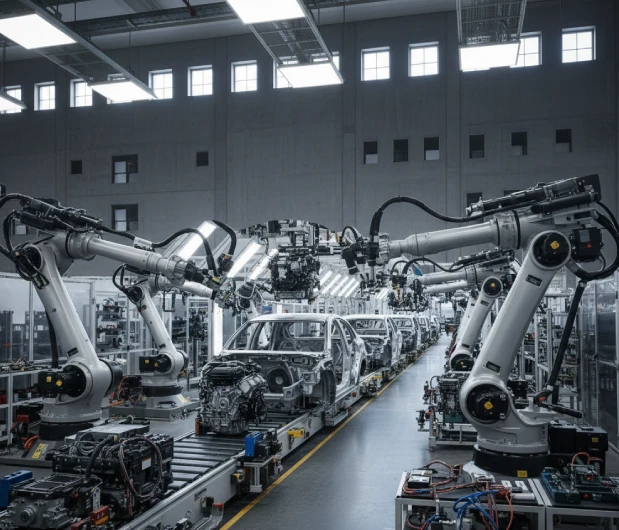
IMARC Engineering delivers smart factory and Industry 4.0 integration across all major manufacturing sectors in India, applying sector-specific regulatory compliance and operational expertise.
21 CFR Part 11-compliant digital batch record systems; IoT-based GMP environmental monitoring with automated alert management; AI-driven process analytical technology for inline quality control; predictive maintenance for GMP-critical equipment; MES integration for batch traceability; and digital maturity roadmap aligned with CDSCO and WHO-GMP data integrity requirements.
FSSAI-compliant digital HACCP monitoring and critical control point data capture; IoT-enabled cold chain temperature telemetry; automated allergen changeover verification; vision-based quality inspection integration; traceability and recall management system implementation; and connected production line OEE monitoring with FSSC 22000-aligned data integrity.
PESO-compliant IoT instrumentation for hazardous area process monitoring; DCS integration with advanced process control for reaction yield optimisation; CPCB-compliant automated emission and effluent monitoring; predictive analytics for equipment corrosion and integrity management; and AI-assisted process optimisation for batch reaction performance improvement.
High-speed line digital performance monitoring and automated downtime classification; vision inspection and serialisation for export market traceability compliance; demand-responsive production scheduling integration; warehouse automation and digital inventory management; supplier traceability integration; and consumer insight-driven production planning analytics for SKU portfolio optimisation.
Batch formulation process automation and digital recipe management; IoT-enabled quality parameter monitoring for CIB&RC compliance documentation; automated label and packaging verification; seasonal production surge predictive planning; cold chain monitoring for bio-pesticide distribution; and supply chain traceability integration for export market regulatory compliance documentation.
Connected shopfloor OEE monitoring and digital production scheduling; machine tool connectivity and CNC data collection for quality traceability; computer vision-based automated inspection; predictive maintenance deployment for critical production equipment; energy management system integration for ISO 50001 compliance; and ERP integration for real-time production versus order visibility.
Explore Related Services
OEE (Overall Equipment Effectiveness) Improvement
Process Optimization and Lean Consulting
Automation and Digital Monitoring Setup
Trusted by Industry Leaders
We partner with global enterprises and ambitious businesses across sectors to deliver operational excellence, strategic insights, and sustainable growth through integrated solutions.












Success in Their Words
Real feedback from clients across industries. Discover how our solutions delivered measurable impact and operational excellence.

I wanted to express my sincere appreciation for your efforts in handling this matter. Your dedication and commitment have been truly commendable, and it is evident that you have put in tremendous hard work and expertise into resolving the issues at hand. We are greatly interested in continuing our collaboration with you in the future, as your professionalism and reliability have made you a trusted partner. Thank you once again for your invaluable contribution. We look forward to strengthening our partnership ahead.

It has been a pleasure working with the IMARC team. The insights provided were structured, clear, and highly valuable, helping us strengthen both our technical and financial planning with confidence. We deeply appreciate the team’s professionalism, responsiveness, and attention to detail throughout the engagement. Every requirement was well understood and effectively incorporated, resulting in a comprehensive and actionable output. Overall, our experience has been excellent, and I would gladly recommend IMARC to organizations seeking a reliable research partner.

Your service is truly exceptional. Working with the IMARC team has been a seamless and professional experience. The clarity of communication, responsiveness to queries, and consistent support at every stage made the entire engagement highly efficient. The insights shared were well-structured, practical, and perfectly aligned with our requirements, helping us make informed decisions with confidence. Overall, the dedication and professionalism demonstrated by your team stand out, and I would be glad to recommend IMARC as a reliable and trustworthy research partner.

IMARC did an outstanding job in preparing our study. They were punctual, precise, and consistently responsive throughout the entire process. The team delivered all the data we required in a clear, well-organized, and highly professional format. Their strong attention to detail, combined with their ability to meet every deadline without compromising quality, truly set them apart. Overall, their reliability and commitment made them an exceptional partner for our project, and we would gladly work with them again in the future.

IMARC made the whole process incredibly easy from start to finish. Everyone I interacted with via email was polite, professional, and straightforward to deal with, always keeping their promises regarding delivery timelines and remaining consistently solutions-focused. From my very first contact, I appreciated the professionalism and support shown by the entire IMARC team. I highly recommend IMARC to anyone seeking timely, affordable, and reliable information or advice. My experience with IMARC was excellent, and I truly cannot fault any aspect of it.

I’d like to express my sincere gratitude for the excellent work you accomplished with the study. Your ability to quickly understand our requirements and deliver high-quality results under tight timelines truly reflects your expertise, exceptional work ethic, and unwavering commitment to your customer’s success. The professionalism and responsiveness you demonstrated throughout the process made a significant difference. Our entire team and company are incredibly thankful for your dedication, reliability, and support. Once again, thank you for your outstanding contribution.
Frequently Asked Questions: Smart Factory and Industry 4.0 Integration in India
We have compiled answers to common questions investors and manufacturing leaders ask about smart factory and Industry 4.0 integration services. These insights address investment requirements, expected returns, implementation timelines, and strategic considerations for digital transformation.
Speak to Our Smart Factory and Industry 4.0 Integration Team
Whether you are a manufacturer or planning an Industry 4.0 roadmap, IMARC Engineering delivers digital transformation solutions combining process expertise and regulatory alignment with Central Drugs Standard Control Organization and Food Safety and Standards Authority of India. This includes digital batch records, IoT-based monitoring, advanced process control, OEE and predictive maintenance systems, and traceability solutions, implemented in phased, ROI-driven programmes to enable intelligent, connected, data-driven manufacturing.