
Comprehensive Reliability Enhancement and Downtime Reduction Services in India
Plan maintenance schedules, inspections, and servicing for manufacturing facilities in India to reduce downtime, improve equipment reliability, and ensure consistent operational performance aligned with Indian standards.
Contact Us

Preventive Maintenance Planning in India
Preventive maintenance planning in India is critical for ensuring equipment reliability, minimizing unplanned downtime, and optimizing lifecycle costs across manufacturing operations. In high-utilization industries such as pharmaceuticals, food processing, and chemicals, where equipment failure can disrupt production and compliance, structured maintenance planning becomes a strategic necessity. Industry estimates indicate that unplanned downtime can reduce plant productivity by 5–20%, while effective preventive maintenance can lower maintenance costs by up to 30% and extend asset life significantly.
IMARC Engineering provides preventive maintenance planning services in India through structured asset mapping, criticality analysis, and data-driven maintenance scheduling. We design maintenance frameworks based on operating conditions, OEM guidelines, and failure history, integrating inspection schedules, lubrication plans, calibration cycles, and spare parts planning. Our approach also includes maintenance documentation systems, KPI tracking (MTBF, MTTR), and audit-ready records aligned with Indian regulatory and quality standards such as GMP, ISO, and NABL practices.
This enables manufacturers to transition from reactive maintenance to a proactive, reliability-driven model, reducing breakdown risks, improving equipment uptime, and ensuring consistent production performance across facilities.
Our Structured Preventive Maintenance Planning Methodology
Our preventive maintenance process provides a structured framework to analyze equipment condition, optimize service intervals, and ensure reliability. It focuses on efficiency, precision, and long-term performance improvement across diverse industrial and manufacturing operations.


Asset Assessment and Criticality Analysis
We evaluate equipment performance, operational importance, and failure likelihood to determine maintenance priorities. This assessment helps allocate resources efficiently, preventing downtime and maximizing reliability across all production-critical systems within a manufacturing facility.

Maintenance Schedule Development
Our team develops structured, data-driven maintenance schedules that specify inspection intervals, service routines, and required spare parts. These schedules align with production cycles to reduce disruption, extend equipment life, and maintain consistent operational efficiency.

Resource and Workflow Optimization
We streamline maintenance processes by coordinating workforce assignments, spare part logistics, and workflow sequencing. Clear work order management ensures maintenance is performed safely, efficiently, and without interfering with ongoing production operations.

Performance Monitoring and Continuous Improvement
Post-maintenance performance data is analyzed to measure reliability gains and identify improvement opportunities. Continuous refinement of schedules and methods ensures sustained operational excellence, cost optimization, and long-term performance stability across all assets.
Why Choose IMARC Engineering for Preventive Maintenance Planning in India?
Our preventive maintenance solutions enhance productivity and reliability through technical expertise, data analytics, and systematic planning. This approach minimizes operational disruptions, optimizes costs, and ensures continuous performance across critical manufacturing systems.

Engineering-Led Maintenance Framework
Preventive maintenance plans developed from OEM manuals alone systematically misallocate maintenance effort, applying the same service interval to production-critical equipment that causes line stoppage on failure and to non-critical equipment whose failure has no production consequence. OEM maintenance intervals are developed for idealised operating conditions that differ from the reality of Indian manufacturing environments: ambient temperatures in Gujarat and Rajasthan exceeding 45°C in summer, dust and humidity conditions in food processing zones, power quality variation from Indian industrial DISCOMs, and process chemical exposure in pharmaceutical and chemical manufacturing that accelerates wear beyond OEM-assumed rates. IMARC Engineering develops preventive maintenance frameworks grounded in equipment criticality analysis and India-specific operating condition assessment, concentrating maintenance effort and frequency on production-critical assets in demanding operating environments, and applying simplified maintenance protocols to non-critical equipment where over-maintenance wastes cost without improving reliability.

Statutory Maintenance Compliance
Manufacturing facilities in India face statutory maintenance obligations across multiple regulatory frameworks whose non-compliance creates both production and legal risk. The Indian Boilers Regulations mandate periodic inspection and certification of registered boilers and pressure vessels at intervals prescribed by the state boiler inspectorate, with lapsed IBR certificates preventing steam system operation under legal authority. The Factories Act 1948 and state factory rules impose periodic inspection obligations for lifting equipment, pressure systems, and electrical installations within factory premises, with Certifying Surgeons and Factory Inspectors authorised to issue prohibition notices for uninspected equipment. PESO regulations impose periodic inspection requirements for petroleum storage and flammable gas handling installations. CEA electrical safety regulations prescribe periodic testing of electrical installations. IMARC Engineering maps every statutory maintenance obligation applicable to the facility’s equipment inventory, builds these obligations into the maintenance schedule as fixed milestones, and maintains compliance documentation that prevents statutory inspection lapses from creating regulatory exposure.

CMMS Implementation
A preventive maintenance plan documented in spreadsheets or paper schedules that is not embedded within a Computerised Maintenance Management System generates compliance only while the planning discipline is actively enforced and reverts to reactive breakdown maintenance within months as work orders are missed, deferred, and forgotten under production schedule pressure. Sustained preventive maintenance performance requires that maintenance work orders are generated automatically by the CMMS at the correct interval, that actual completion is recorded against each work order, that overdue work orders are escalated to management, and that maintenance performance KPIs including MTBF, MTTR, and planned maintenance compliance percentage are tracked systematically. IMARC Engineering configures preventive maintenance plans within the client’s existing CMMS platform, whether SAP PM, IBM Maximo, Infor EAM, or a locally deployed system, with item master records, maintenance task lists, work order trigger parameters, and KPI dashboards that make preventive maintenance compliance a managed operational function rather than a planning document.

GMP and Regulatory Audit-Ready Maintenance Documentation
Preventive maintenance documentation is a direct subject of CDSCO GMP inspections for pharmaceutical manufacturing facilities and FSSAI audits for food processing facilities, with inspectors reviewing maintenance records for production-critical equipment as evidence that the facility’s quality management system is effectively managed. Schedule M requires that pharmaceutical manufacturing equipment is maintained to a defined maintenance schedule with records available for CDSCO inspection, and that maintenance-related deviations are investigated through the facility’s deviation management system. FSSAI audits under FSSC 22000 and HACCP frameworks require documented preventive maintenance programmes for equipment at HACCP critical control points. NABL-accredited testing laboratories require calibration and maintenance records meeting ISO/IEC 17025 standards. IMARC Engineering structures maintenance documentation to satisfy the specific format and content requirements of each applicable regulatory framework, ensuring that maintenance records support rather than compromise the facility’s regulatory audit outcomes.

Calibration Programme Integration
Calibration programme management is an integral component of preventive maintenance planning in Indian manufacturing because uninspected instrument drift in process control, quality testing, and environmental monitoring equipment generates both production quality failures and regulatory compliance gaps that preventive maintenance scheduling must address alongside mechanical equipment maintenance. CDSCO Schedule M requires that all instruments used in pharmaceutical manufacturing are calibrated at defined intervals with records maintained for inspection. NABL-accredited laboratory instruments require calibration traceable to national standards under ISO/IEC 17025. FSSAI requires calibration of food safety critical measurement equipment including temperature monitoring, pH meters, and process control instruments. IMARC Engineering integrates calibration schedules for all measurement and control instruments into the preventive maintenance framework, with calibration due dates, calibration method references, acceptance criteria, and out-of-tolerance response procedures documented in the CMMS alongside mechanical maintenance tasks.

Maintenance KPI Framework and Performance Monitoring
Preventive maintenance planning that does not include a structured KPI framework provides no mechanism for measuring whether the maintenance programme is delivering the reliability improvement it is designed to achieve, and no evidence base for refining maintenance intervals as operating experience accumulates. Mean Time Between Failures tracks whether equipment reliability is improving as the preventive maintenance programme matures. Mean Time To Repair measures maintenance team responsiveness and spare parts availability efficiency. Planned Maintenance Compliance percentage measures whether work orders are being executed at the planned interval or deferred. Overall Equipment Effectiveness provides a combined measure of availability, performance, and quality that integrates maintenance performance with production outcomes. IMARC Engineering establishes a maintenance KPI dashboard at programme implementation that tracks these metrics on a weekly and monthly basis, enabling the facility’s maintenance management team to identify equipment whose maintenance programme requires frequency adjustment, spare parts programme enhancement, or condition-based monitoring upgrade as operational data accumulates.
Preventive Maintenance Planning Across Key Sectors in India
IMARC Engineering delivers asset criticality assessment, statutory compliance maintenance scheduling, CMMS configuration, GMP audit-ready documentation, calibration programme integration, and maintenance KPI implementation across India’s most active manufacturing sectors.
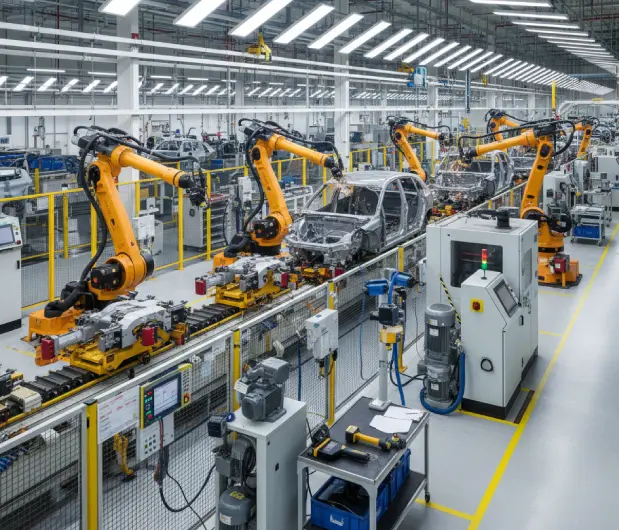
Preventive maintenance planning for pharmaceutical manufacturing equipment across Hyderabad, Baddi, Ahmedabad, and Aurangabad clusters. CDSCO Schedule M GMP maintenance documentation, calibration programme for process control and quality testing instruments, IBR boiler and autoclave statutory inspection scheduling, CMMS configuration for maintenance work order management, and MTBF-based maintenance interval optimisation for critical manufacturing equipment.
Preventive maintenance planning for food processing equipment including pasteurisers, homogenisers, filling lines, and cold chain systems. FSSAI and HACCP critical control point equipment maintenance scheduling, FSSC 22000-aligned maintenance documentation, refrigeration system statutory inspection coordination, calibration programme for temperature and pH monitoring equipment, and OEE tracking for high-utilisation food processing lines.
Preventive maintenance planning for chemical manufacturing equipment in Gujarat’s Dahej, Ankleshwar, and Vapi corridors. IBR pressure vessel and boiler statutory inspection scheduling, PESO installation periodic inspection management, mechanical seal and rotating equipment maintenance programme for corrosive service environments, calibration programme for process safety instrumentation, and BEE PAT scheme energy performance maintenance tracking.
Preventive maintenance planning for high-speed filling, packaging, and labelling equipment. OEE-driven maintenance interval optimisation for continuous-operation packaging lines, CDSCO cosmetics facility maintenance documentation, lubrication and wear part replacement scheduling for high-speed mechanical components, CMMS configuration for multi-vendor packaging line maintenance management, and calibration programme for filling accuracy and weight control instruments.
Preventive maintenance planning for agrochemical manufacturing equipment in PESO-notified chemical zones. PESO periodic inspection scheduling for petroleum and hazardous chemical handling installations, toxic service mechanical seal maintenance programme, IBR statutory inspection management for steam-heated process equipment, CPCB effluent treatment system maintenance scheduling, and safety interlock and gas detection system periodic functional testing.
Preventive maintenance planning for medical device manufacturing equipment. ISO 13485 preventive maintenance documentation aligned with quality management system requirements, NABL calibration programme for metrology and inspection equipment, cleanroom HVAC preventive maintenance scheduling including HEPA filter integrity testing intervals, CDSCO facility maintenance record format for Class B and C device manufacturing licence compliance, and precision manufacturing equipment OEE tracking.
Preventive maintenance planning for heavy manufacturing equipment in MIDC, GIDC, SIDCO, and RIICO industrial areas. CNC machine tool and heat treatment furnace maintenance scheduling, Factory Act statutory inspection management for lifting equipment and pressure systems, lubrication programme for heavy rotating and reciprocating equipment, BEE energy efficiency norm compliance maintenance tracking, and CMMS configuration for large industrial facility multi-equipment maintenance management.
Explore Related Services
Post-Commissioning Performance Validation
Standard Operating Procedure (SOP) Development
Workforce Planning and Technical Staffing
Trusted by Industry Leaders
We partner with global enterprises and ambitious businesses across sectors to deliver operational excellence, strategic insights, and sustainable growth through integrated solutions.











Success in Their Words
Real feedback from clients across industries. Discover how our solutions delivered measurable impact and operational excellence.

I wanted to express my sincere appreciation for your efforts in handling this matter. Your dedication and commitment have been truly commendable, and it is evident that you have put in tremendous hard work and expertise into resolving the issues at hand. We are greatly interested in continuing our collaboration with you in the future, as your professionalism and reliability have made you a trusted partner. Thank you once again for your invaluable contribution. We look forward to strengthening our partnership ahead.

It has been a pleasure working with the IMARC team. The insights provided were structured, clear, and highly valuable, helping us strengthen both our technical and financial planning with confidence. We deeply appreciate the team’s professionalism, responsiveness, and attention to detail throughout the engagement. Every requirement was well understood and effectively incorporated, resulting in a comprehensive and actionable output. Overall, our experience has been excellent, and I would gladly recommend IMARC to organizations seeking a reliable research partner.

Your service is truly exceptional. Working with the IMARC team has been a seamless and professional experience. The clarity of communication, responsiveness to queries, and consistent support at every stage made the entire engagement highly efficient. The insights shared were well-structured, practical, and perfectly aligned with our requirements, helping us make informed decisions with confidence. Overall, the dedication and professionalism demonstrated by your team stand out, and I would be glad to recommend IMARC as a reliable and trustworthy research partner.

IMARC did an outstanding job in preparing our study. They were punctual, precise, and consistently responsive throughout the entire process. The team delivered all the data we required in a clear, well-organized, and highly professional format. Their strong attention to detail, combined with their ability to meet every deadline without compromising quality, truly set them apart. Overall, their reliability and commitment made them an exceptional partner for our project, and we would gladly work with them again in the future.

IMARC made the whole process incredibly easy from start to finish. Everyone I interacted with via email was polite, professional, and straightforward to deal with, always keeping their promises regarding delivery timelines and remaining consistently solutions-focused. From my very first contact, I appreciated the professionalism and support shown by the entire IMARC team. I highly recommend IMARC to anyone seeking timely, affordable, and reliable information or advice. My experience with IMARC was excellent, and I truly cannot fault any aspect of it.

I’d like to express my sincere gratitude for the excellent work you accomplished with the study. Your ability to quickly understand our requirements and deliver high-quality results under tight timelines truly reflects your expertise, exceptional work ethic, and unwavering commitment to your customer’s success. The professionalism and responsiveness you demonstrated throughout the process made a significant difference. Our entire team and company are incredibly thankful for your dedication, reliability, and support. Once again, thank you for your outstanding contribution.
Frequently Asked Questions: Preventive Maintenance Planning in India
We have compiled investor-focused insights addressing implementation, efficiency, and financial impact of preventive maintenance planning for industrial and commercial operations. This section answers the most common questions about preventive maintenance planning, offering investors and operators practical insights into the same.
Speak to Our Preventive Maintenance Planning Team
Whether you are a pharmaceutical company, a food company, a chemicals company, an FMCG company, a medical devices company, or an industrial manufacturing company, and even if you’re an investor, IMARC Engineering can help you with our engineering-based maintenance strategies and compliance solutions. These range from maintenance based on good manufacturing practices in line with the Central Drugs Standard Control Organization, food safety solutions for the Food Safety and Standards Authority of India, and others.