From First Output to Full Capacity: Structured Production Ramp-Up in India
Accelerate manufacturing stabilization with structured production ramp-up monitoring in India, combining real-time performance tracking, engineering oversight, and data-driven insights to minimize delays, optimize throughput, and achieve steady-state operations faster.
Contact Us
Production Ramp-up Monitoring in India
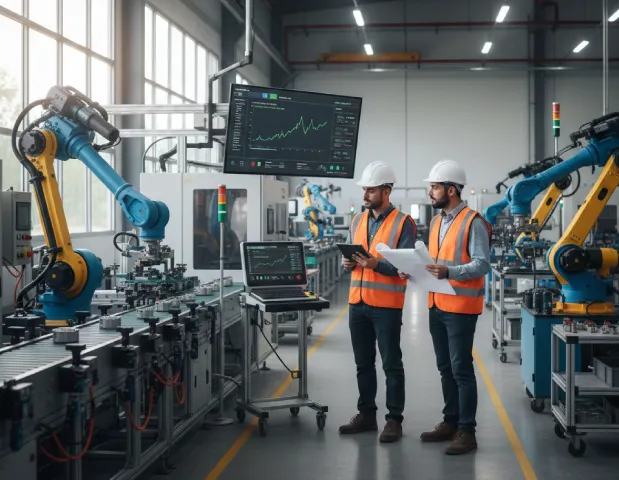
Production ramp-up in India is a critical phase where manufacturing facilities transition from commissioning to stable, full-capacity operations. Inefficiencies during this stage, such as equipment instability, process variability, and workforce readiness gaps can lead to production losses, quality issues, and delayed market entry. Industry estimates suggest that poorly managed ramp-ups can reduce initial production efficiency by 20–30%.
IMARC Engineering provides structured production ramp-up services in India, enabling manufacturers to achieve faster operational stability and predictable output. Our approach integrates real-time performance tracking, variance analysis, and engineering-led interventions across equipment performance, material flow, and operator readiness. We identify deviations early, optimize process parameters, and improve coordination across production, maintenance, and quality teams, ensuring higher throughput, reduced downtime, and consistent product quality during scale-up.
With India witnessing increasing investments in manufacturing and industrial expansion, effective ramp-up and stabilization is essential for minimizing scale-up risks, improving operational efficiency, and accelerating time-to-market, while enabling faster transition to steady-state production.
Our Production Ramp-up Monitoring Methodology
Our structured production ramp-up monitoring process ensures precise control, continuous evaluation, and systematic improvement throughout production scale-up. Each stage is data-driven, enabling consistent output, minimized downtime, and enhanced operational readiness.

Pre-Ramp-Up Assessment and Planning
We define objectives, collect baseline data, and identify process sensitivities to prepare operations, ensuring all systems, materials, and personnel are aligned for a stable startup phase.

Performance Tracking and Data Analysis
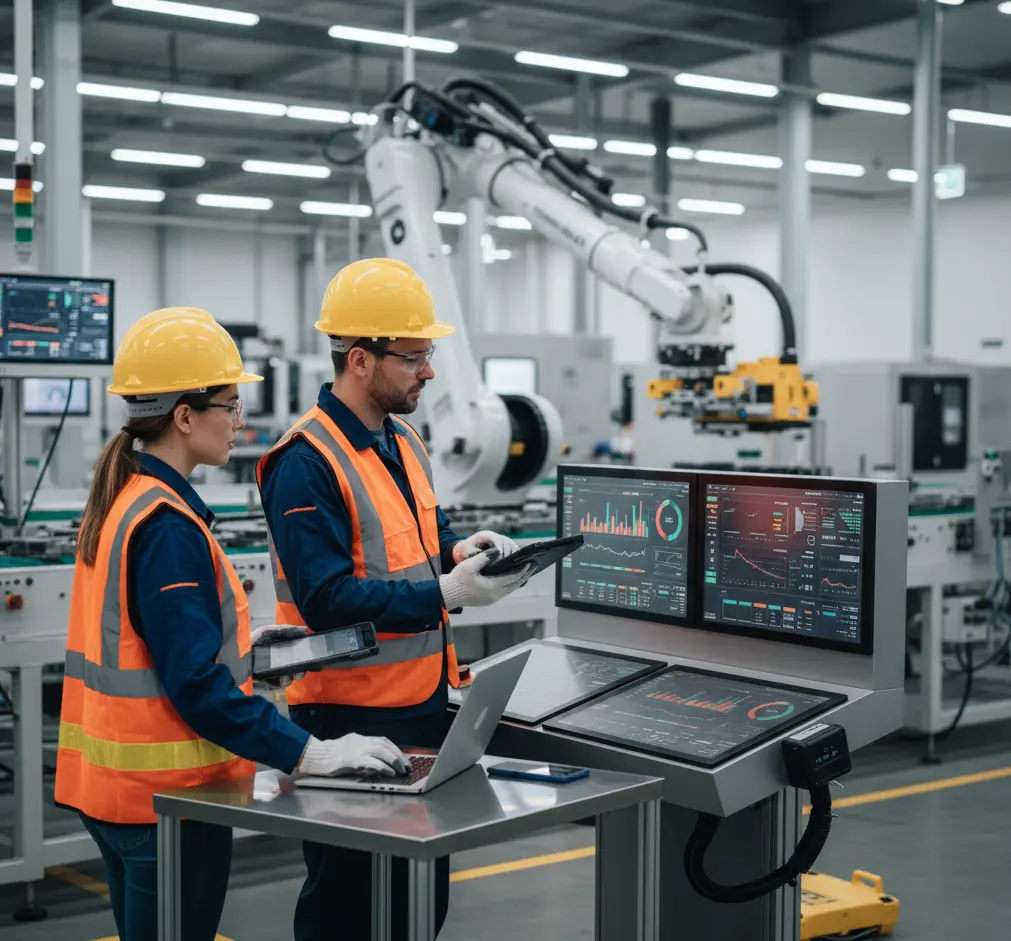
Real-time metrics such as cycle time, yield, and equipment utilization are monitored to detect deviations, inefficiencies, or control issues during early production activities.

Corrective Action and Optimization
Observed discrepancies are analyzed, root causes identified, and process adjustments implemented through coordinated efforts between engineering, production, and maintenance teams.

Stabilization and Performance Validation
We confirm sustained achievement of performance targets, verify efficiency levels, and document improvements to validate operational readiness for long-term continuous production.
Why Choose IMARC Engineering for Production Ramp-up Monitoring in India?
Our ramp-up monitoring methodology integrates real-time analytics, process engineering, and performance management to deliver precise production acceleration. This systematic approach ensures stability, efficiency, and measurable gains across every stage of scaling operations.

Engineering-Led Ramp-Up Management
Indian manufacturing production ramp up problems often tend to be treated as a reactive solution, where the obvious deficiency is addressed in terms of extending operational time, operating equipment outside its design parameters or allowing for reduced quality standards instead of tackling the problem at source. An example would be where a tablet press is not meeting expected production numbers as part of the ramp up process. This may be due to one of several problems, such as the fact that a granulation process parameter was not optimized in the actual manufacturing process, tooling alignment issues leading to excess punch wear beyond the point of validation, or simply an issue with the operator not being able to effectively control the feeding system. The IMARC Engineering ramp up methodology involves using root cause analysis on all production performance issues, determining if it is a question of equipment, process, material or workforce and taking appropriate steps to address the root cause of the problem.

PLI Scheme Performance Commitment Tracking
Manufacturing units in India that have made a commitment to reach the performance criteria in respect of the Performance-Linked Incentives scheme for any industry sector such as pharmaceuticals, food processing, advanced chemistry cells, medical devices, and other PLI sectors are subject to a specific financial penalty as a result of any delays in ramping up production that cause failure in reaching their required level of production and investments for the year under review. The loss of an incentive entitlement in the pharmaceutical PLI scheme, for example, in the first year of performance is not recoverable in any subsequent year. Similarly, the food processing PLI facility that has failed in meeting its second year of production due to problems associated with equipment ramping up will suffer a clawback of previously disbursed incentives. IMARC Engineering tracks ramping up production relative to PLI performance obligations as a dedicated tracking exercise.

Lender Draw-Down Condition Verification
Project financing of manufacturing facilities in India usually involves draw-downs based on production ramp-up achievements where the last drawdown from construction to the operations phase facility is available only after achieving certain percentage of production of the design capacity of the facility. Performance evaluations of production ramp-up for meeting the requirements of these milestones are done by independent engineers engaged by the lending syndicate, and negative evaluations delay the process of drawdown and adversely affect cash flows of the project during the critical phase of transitioning from construction to operations. IMARC Engineering designs its documentation for the purpose of monitoring the production ramp-up of projects such that the performance of production and other criteria are recorded on a daily and weekly basis in terms that meet the standards expected by the lenders' independent engineers at each milestone.

Multi-Discipline Intervention Capability
Underperformance during ramp-up for production on manufacturing operations in India almost never has only one source. Underperformance is a function of both equipment calibration problems, process parameter problems relative to design conditions, quality problems of raw materials supplied by known suppliers, utility supply problems from Indian electricity and water supply, and operator knowledge problems that would individually lead to manageable interruptions but together make it impossible to run the entire plant at maximum capacity. Dealing with underperformance of this type means having the ability to monitor and intervene on all fronts simultaneously. The ramp-up monitoring team at IMARC Engineering is able to do just that because the group has a multi-discipline approach to solving production problems.

Real-Time Performance Tracking
Through continuous data monitoring and issue escalation protocols, we identify and mitigate Performance tracking without a performance tracking system will lead to qualitative progress reviews that are not capable of pinpointing which equipment, which processes, or which shifts are holding up the performance of the entire assembly line. When the production plant manager states that ramp-up is “going well,” he/she might be ignoring the actual situation where production in the first shift is meeting expectations, but output in the second and third shifts is 25 percent below expectation because of the variation in the skills of the operators, only to be known through systematic tracking by shift. IMARC Engineering has an in-built performance tracking system from day one of the start of production operations that measures hourly and shift-wise production output, equipment availability/downtime by reason, first-pass quality yield, and raw materials consumed as compared to what was designed. These performances are reviewed on a daily/weekly basis to highlight areas that need intervention by engineers/managers before a production shortfall results.

Steady-State Handover Documentation
The goal of production ramp-up monitoring is not eternal engineering support but reaching an established steady state condition where the operating personnel of the facility can produce product in compliance with requirements at full capacity independently. Ramp-up engagements that lack both a steady state achievement criteria and handover process typically continue without end, leaving facilities dependent on engineering support for eternity while failing to develop their own capabilities of operating independently. IMARC Engineering sets forth the steady state achievement criteria at the beginning of the ramp-up project, outlining the specific production volume, equipment performance indicators, quality yield and operator competencies necessary to establish steady state operation, and runs the ramp-up process to achieve these criteria. At steady state achievement, IMARC Engineering will turn over the facility and provide all necessary documentation for continued independent operations by the facility personnel.
Production Ramp-up Monitoring Across Key Sectors in India
IMARC Engineering delivers engineering-led ramp-up monitoring, PLI performance tracking, variance analysis, multi-discipline intervention, and steady-state handover documentation across India’s most active manufacturing sectors.
Ramp-up monitoring for pharmaceutical manufacturing facilities across Hyderabad, Baddi, and Ahmedabad clusters. PLI scheme incremental production threshold tracking, CDSCO Schedule M quality yield monitoring during initial commercial batches, GMP deviation root cause analysis during ramp-up, equipment OEE tracking for tablet compression, granulation, and fill-finish lines, and lender independent engineer production milestone reporting.
Ramp-up monitoring for food processing facilities across agricultural processing zones in Punjab, Maharashtra, and Karnataka. FSSAI critical control point performance tracking during initial production, PLI food processing scheme production commitment monitoring, seasonal raw material quality variability impact assessment, filling and packaging line speed and yield ramp-up tracking, and cold chain system performance verification during operational stabilisation.
Ramp-up monitoring for chemical manufacturing facilities in Gujarat’s Dahej, Ankleshwar, and Vapi industrial corridors. Reaction yield and conversion tracking against design parameters during initial campaign runs, utility consumption benchmarking against process design basis, CPCB effluent quality monitoring during ramp-up, safety interlock system performance verification under production conditions, and process parameter optimisation for specialty chemical yield improvement.
Ramp-up monitoring for FMCG manufacturing facility production start-up. High-speed filling and packaging line OEE tracking, multi-SKU production changeover time optimisation during ramp-up, CDSCO cosmetics quality yield monitoring during initial production batches, operator competency assessment for high-speed line operations, and PLI adjacency scheme production commitment tracking for eligible FMCG product categories.
Ramp-up monitoring for agrochemical manufacturing facility production stabilisation. Technical grade yield and purity tracking against CIB&RC-registered product specifications during initial campaign runs, formulation process parameter optimisation, CPCB effluent quality compliance monitoring during ramp-up, PESO safety system performance verification under production conditions, and raw material quality variability impact assessment for Indian agricultural feedstocks.
Ramp-up monitoring for medical device manufacturing facility production start-up. ISO 13485 process validation performance monitoring during initial production batches, CDSCO Class B and C device quality yield tracking, precision manufacturing equipment OEE and dimensional conformance tracking during ramp-up, calibration system performance verification, and PLI medical devices scheme production and investment commitment milestone monitoring.
Ramp-up monitoring for heavy manufacturing and industrial facility production start-up. CNC machine tool throughput and first-pass quality yield tracking, heat treatment and surface finishing process parameter optimisation during initial production runs, Factory Act-compliant production safety performance monitoring, BEE energy efficiency benchmark tracking against designed consumption parameters, and lender draw-down condition production milestone documentation for industrial sector project finance.
Explore Related Services
Standard Operating Procedure (SOP) Development
Preventive Maintenance Planning
Workforce Planning and Technical Staffing
Decommissioning and Site Closure Support
Trusted by Industry Leaders
We partner with global enterprises and ambitious businesses across sectors to deliver operational excellence, strategic insights, and sustainable growth through integrated solutions.











Success in Their Words
Real feedback from clients across industries. Discover how our solutions delivered measurable impact and operational excellence.

I wanted to express my sincere appreciation for your efforts in handling this matter. Your dedication and commitment have been truly commendable, and it is evident that you have put in tremendous hard work and expertise into resolving the issues at hand. We are greatly interested in continuing our collaboration with you in the future, as your professionalism and reliability have made you a trusted partner. Thank you once again for your invaluable contribution. We look forward to strengthening our partnership ahead.

It has been a pleasure working with the IMARC team. The insights provided were structured, clear, and highly valuable, helping us strengthen both our technical and financial planning with confidence. We deeply appreciate the team’s professionalism, responsiveness, and attention to detail throughout the engagement. Every requirement was well understood and effectively incorporated, resulting in a comprehensive and actionable output. Overall, our experience has been excellent, and I would gladly recommend IMARC to organizations seeking a reliable research partner.
Your service is truly exceptional. Working with the IMARC team has been a seamless and professional experience. The clarity of communication, responsiveness to queries, and consistent support at every stage made the entire engagement highly efficient. The insights shared were well-structured, practical, and perfectly aligned with our requirements, helping us make informed decisions with confidence. Overall, the dedication and professionalism demonstrated by your team stand out, and I would be glad to recommend IMARC as a reliable and trustworthy research partner.

IMARC did an outstanding job in preparing our study. They were punctual, precise, and consistently responsive throughout the entire process. The team delivered all the data we required in a clear, well-organized, and highly professional format. Their strong attention to detail, combined with their ability to meet every deadline without compromising quality, truly set them apart. Overall, their reliability and commitment made them an exceptional partner for our project, and we would gladly work with them again in the future.

IMARC made the whole process incredibly easy from start to finish. Everyone I interacted with via email was polite, professional, and straightforward to deal with, always keeping their promises regarding delivery timelines and remaining consistently solutions-focused. From my very first contact, I appreciated the professionalism and support shown by the entire IMARC team. I highly recommend IMARC to anyone seeking timely, affordable, and reliable information or advice. My experience with IMARC was excellent, and I truly cannot fault any aspect of it.

I’d like to express my sincere gratitude for the excellent work you accomplished with the study. Your ability to quickly understand our requirements and deliver high-quality results under tight timelines truly reflects your expertise, exceptional work ethic, and unwavering commitment to your customer’s success. The professionalism and responsiveness you demonstrated throughout the process made a significant difference. Our entire team and company are incredibly thankful for your dedication, reliability, and support. Once again, thank you for your outstanding contribution.
Frequently Asked Questions: Production Ramp-up Monitoring in India
We have compiled detailed insights addressing key investor concerns related to production ramp-up monitoring. These responses explain how our solutions enhance efficiency, reduce operational risks, and ensure smooth transitions from commissioning to full-scale production.
Speak to Our Production Ramp-up Monitoring Team
Whether you are a pharmaceutical, food, chemical, FMCG, agrochemical, medical device, or industrial manufacturer, or an investor or lender, IMARC Engineering provides engineering-led ramp-up and process monitoring support. This includes GMP and PLI tracking aligned with Central Drugs Standard Control Organization and Food Safety and Standards Authority of India requirements, yield and utility performance analysis, OEE optimisation, and structured reporting. Our approach ensures rapid stabilisation, regulatory compliance, and efficient transition to full-capacity operations.